How will you observe Orange Shirt Day and National Day for Truth and Reconciliation?
At the College of Health and Care Professionals of BC, we know we operate in a system that is shaped by colonialism, which continues to influence our processes and decision-making.
We know that while our role is to ensure everyone seeking care receives safe, quality health services, Indigenous people continue to experience harm in BC’s healthcare system.
And we know that we have a legal obligation under the Health Professions and Occupations Act to support and promote awareness of reconciliation with Indigenous peoples, the UN Declaration on the Rights of Indigenous Peoples, and the need to address racism and anti-racism specific to Indigenous peoples.
September 30—Orange Shirt Day and National Day for Truth and Reconciliation—is a day intended to honour residential school survivors, their families, and communities, and ensure that public commemoration of the history and legacy of residential schools remains a vital component of the reconciliation process.
Incorporating anti-racism and anti-discrimination into our regulatory activities
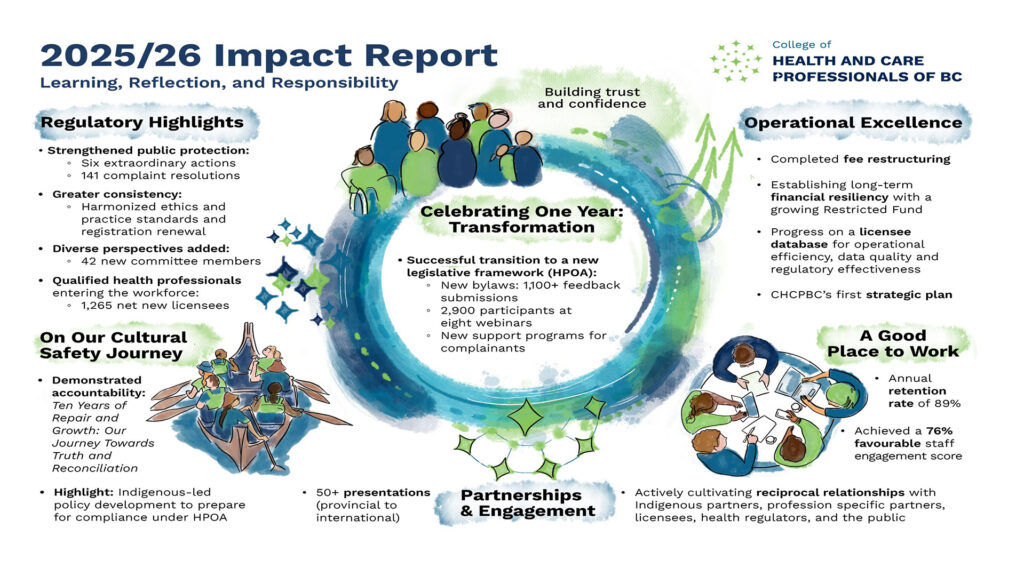
CHCPBC is deliberately incorporating Indigenous-specific anti-racism and anti-discrimination into our core regulatory activities. For example, the new Professional and Quality Practice Program (PQPP): Indigenous cultural safety, anti-racism, and anti-discrimination are woven into the PQPP Annual Touchpoints, as well as practice support and future resources.
The Investigations, Discipline and Monitoring department has committed to ensuring that each team member completes San’yas Indigenous Specific Anti-Racism Training in addition to Trauma-Informed Investigations Training. Its next step is to conduct a review of all templates through a cultural safety and trauma-informed lens.
The Licensure team is currently assessing an option to the fulfill the requirement of bylaws 6.3 (a) (ii) (F), a course on cultural safety and humility, including Indigenous-specific and other anti-racism approaches.
For more information on the College’s work to eradicate Indigenous-specific racism, please refer to CHCPBC’s report Ten Years of Repair and Growth: Our Journey Towards Truth and Reconciliation (PDF).
Why we wear orange
“The orange shirt has become a symbol of hope, reconciliation, and commitment to a better future. By wearing an orange shirt on September 30th, you make a statement to support truth & reconciliation and commit to the enduring truth that
“EVERY CHILD MATTERS”
–Orange Shirt Society
The story of Phyllis Webstad, a residential school survivor, is the foundation of Orange Shirt Day. At the age of six, Phyllis’s new orange shirt was taken away on her first day at St. Joseph Mission Residential School. As explained by the Orange Shirt Day Society, this represented how the system tried to strip away identity, culture, and the fundamental truth that Every Child Matters. Orange Shirt Day has since become a national movement,
Wearing an orange shirt to commemorate September 30 shows our support and solidarity with Indigenous people during this month of ceremony, healing and wellness for Indigenous people.
Resources on Indigenous Cultural Safety, Cultural Humility, and Anti-Racism
Below are various resources that can help support the learning and understanding that are required for reconciliation.
- There is a listing of resources to support understanding and application of the Indigenous Cultural Safety, Cultural Humility, and Anti-Racism Practice Standard (PDF).
- Watch the licensee webinar Legal Framework for Human Rights Obligations under the Health Professions and Occupations Act, led by Angie Westmacott and Len Pierre.
- Watch the recording of the licensee webinar Cultivating Safe Spaces: Self Care, Belonging, and Human Capacity, led by Elaine Alec.
- Hear stories from survivors of Residential Schools or refresh your knowledge of the In Plain Sight report.
Virtual and in-person events
Virtual events
- National Centre for Truth and Reconciliation Lunch and Learns
- Remembering the Children: National broadcast from Parliament Hill (September 30 at noon Pacific)
In person events
Metro Vancouver
- Intergenerational March to Commemorate Orange Shirt Day at UBC (September 30)
- Screening of Laxwesa Wa: Strength of the River at Michael Wright Art Gallery in Port Coquitlam (September 26)
- The Path Forward with the Vancouver Symphony Orchestra Indigenous Council at Orpheum in Vancouver (September 27)
- Rhythms of Resilience: Our Children, Our Future at Japanese Hall in Vancouver (September 24)
- Truth and Reconciliation Day at MONOVA in North Vancouver (September 30)
- National Day for Truth and Reconciliation at Arts Umbrella on Granville Island (September 30)
- National Day for Truth and Reconciliation at Place des Arts in Coquitlam (September 30)
- Truth and Reconciliation Free Screening at Trout Lake Community Centre (September 30)
- National Day for Truth and Reconciliation in Maple Ridge (September 27)
- Stetís ímexstowx Walk Beside Us at Thunderbird Memorial Square in Abbotsford (September 30)
Thompson-Okanagan
- Walk for Children in Penticton (September 30)
- National Day for Truth and Reconciliation at the North Okanagan Friendship Center in Vernon (September 30)
- Truth and Reconciliation (Un)Learn in Kelowna (September 30)
Squamish-Lillooet
- National Day for Truth and Reconciliation at the Squamish Lil’wat Cultural Centre in Whistler (September 30)
Vancouver Island
- South Island Powwow in Victoria (September 30)
- Orange Shirt Day at the University of Victoria (September 29)
Orange Shirt Day and the National Day for Truth and Reconciliation
Orange Shirt Day and the National Day for Truth and Reconciliation share a date, but were created separately. The story of Phyllis Webstad was the foundation of Orange Shirt Day, which began in 2013.
The National Day for Truth and Reconciliation became a federal statutory holiday in 2021. It was established in response to Call to Action 80 of the Truth and Reconciliation Commission, which called upon the federal government, in collaboration with Indigenous peoples, to create a statutory holiday recognizing Survivors, their families, and communities, and ensure that public commemoration of the history and legacy of residential schools remains a vital component of the reconciliation process.